

News & Insights
Unlicensed works and installations in Galicia: what risks you take on
"It's already done, it's been like that for years, nothing is going to happen."
It's a common line when we talk about house extensions, enclosed terraces, outbuildings or installations that were carried out without the necessary paperwork. But the fact that a building has been standing for years does not necessarily mean its planning status is settled.
In some cases it can be legalised. In others, the time limit for certain measures to restore planning legality will have run out. And there are also situations in which the authorities can require it to be removed or demolished. The key is knowing what was built, when, where and under which regulations.
What happens when works are carried out without a licence?
Galicia's Land Act (Lei 2/2016, do solo de Galicia) sets out different consequences for planning actions carried out without the required authorisation. Infringements are classed as minor, serious or very serious. Minor infringements lapse after two years; serious ones and most very serious ones, after six; and very serious infringements affecting green spaces, open spaces, public facilities, amenities or roads, after fifteen.
For example, works carried out without a licence or prior notification, but which comply with planning regulations and can be legalised, are a minor infringement, which lapses after two years.
However, there is something important that many owners are unaware of: the time limit on an infringement — which prevents a penalty being imposed — is not the same as the deadline for ordering planning legality to be restored, which is what affects the works themselves.
For completed works, Article 153 of Galicia's Land Act generally sets a period of six years from full completion for the procedure to restore legality to be opened. It is opened by the mayor's office of the town council; on rustic land, depending on the type of works, the Galician Agency for the Protection of Planning Legality (APLU) also has jurisdiction.
There is one especially relevant exception: for works requiring a licence that affect green spaces, open spaces, roads, or public facilities and amenities, the power to restore legality never expires. For works subject only to prior notification on that same land, however, the general six-year period still applies.
So not all unlicensed works carry the same consequences, and the mere passing of time does not guarantee that a building becomes legal.
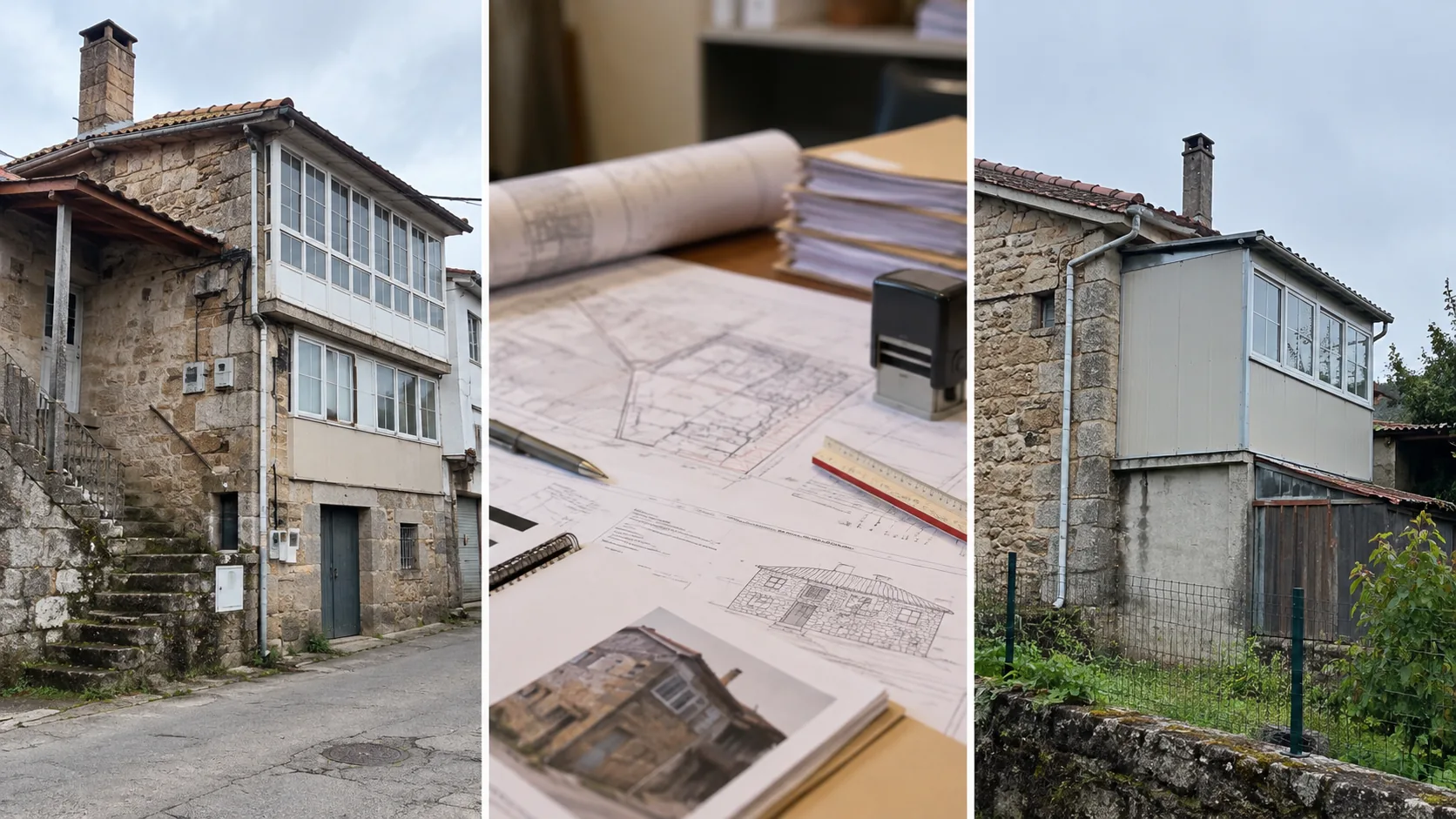
What happens once more than six years have passed?
When the legal period has run out without measures being taken to restore legality, the building falls under the regime set out in Article 90 of Galicia's Land Act.
This does not mean the works have automatically become legal. The building enters a restricted regime: it can undergo conservation, maintenance, refurbishment and restoration works, but it can never be extended.
In addition, the completion date of the works must be properly proven, and it must be checked that none of the exceptions preventing that regime from applying is present.
Can you sell or inherit a house with unlicensed works?
In principle, yes. Unlicensed works do not automatically prevent a property from being sold or inherited, but they can complicate the process. An extension that does not appear in the Land Registry, a built area that does not match the documentation, or a building whose planning status is uncertain can cause problems during a sale, a mortgage valuation or the division of an inheritance.
In certain cases it is possible to file a declaration of a new building by age ("obra nueva por antigüedad"), provided the legal requirements are met. This procedure allows older buildings to be entered in the Land Registry when measures to restore legality involving their demolition can no longer be taken.
But there is a fundamental difference: registering a building by age is not the same as obtaining a planning licence, nor does it remove the limitations that may affect it. That is why, before buying or selling, it is worth checking the property's real situation.
What risks does the buyer of a house with illegal works take on?
An order to restore planning legality can affect the property even after it has changed hands. Buying in good faith does not necessarily remove the restoration obligations attached to the property.
Administrative penalties have their own liability regime, but measures to restore legality can reach whoever owns the property at the time. A planning review before buying makes it possible to detect these problems before taking them on.
Can unlicensed works be a criminal offence?
Not all unlicensed works amount to a planning offence. However, Article 319 of the Spanish Criminal Code provides for criminal liability for developers, builders and technical directors in certain cases of unauthorisable works, particularly when they affect non-developable land — rustic land, in Galicia — or specially protected land.
The consequences can include prison sentences, fines and professional disqualification, and the courts can order, where the law provides for it, the demolition of the works. These are specific situations that must be distinguished from works that simply lack a licence but are compatible with planning regulations.
And if what isn't regularised is an activity or installation?
The problems are not limited to homes. A shop, a workshop, an industrial unit or a technical installation can also be in an irregular administrative situation. In Galicia, many business activities are processed through prior notification, although certain activities still require specific authorisations.
Missing the required documentation or failing to meet technical conditions can lead to inspections, penalties, suspension of the activity or orders to carry out adaptation works. It can also make it harder to access certain grants or to prove the requirements needed to carry on the activity.
As for insurance, it is worth reviewing the conditions of each policy and the circumstances of any claim. A lack of regularisation does not automatically mean loss of cover, but it can have consequences depending on the case.
How can older works be regularised?
There is no single solution: the procedure depends on the characteristics of the building and its planning situation. Usually, the first step is a technical study that checks the land classification and applicable regulations, reviews existing licences, prior notifications and documentation, proves the age of the building where necessary, identifies sectoral constraints and planning limitations, and determines whether a legalisation project, a declaration of a new building by age or another course of action is appropriate.
If the works are compatible with the local plan, they can be legalised through the relevant procedure. Where an older building can no longer be subject to restoration measures, its documentary and registry recognition can be explored, with whatever limitations apply. And where the works cannot be legalised, the options for adapting them to the regulations, or the planning consequences that apply, will need to be assessed.
Before you consider the matter closed, check your property's situation
A building is not necessarily regularised just because it appears in the Cadastre, because it was finished many years ago or because it has never been reported. Nor does it mean that every unlicensed building has to be demolished. What matters is knowing its legal and technical situation before starting a renovation, selling, buying or making an investment.
At CONCRETO we study the planning viability of existing buildings, extensions and installations, identifying the possible routes to legalisation and regularisation and the documentation needed in each case. A timely technical check lets you make informed decisions and avoid problems later on.
Frequently asked questions
How long do I have to wait to legalise works carried out without a licence?
There is no need to wait if the works can be legalised: the relevant procedure can be started as soon as they meet the applicable planning requirements. The time limit on the infringement and the deadline for restoring planning legality are two different things.
Can I sell a house with an unlicensed extension?
Generally yes, but its planning and registry status can affect the sale, the valuation and any mortgage. It is advisable to check the documentation before completing the transaction.
Are works older than six years automatically legal?
No. Once six years have passed without any measures to restore legality, the building falls under the restricted regime of Article 90 of Galicia's Land Act — it cannot be extended — but it does not obtain a licence. There are also exceptions: for works requiring a licence on green spaces, roads, or public facilities and amenities, that time limit does not apply.
Is every case of unlicensed works a crime?
No. Criminal liability is reserved for specific cases under Article 319 of the Spanish Criminal Code, in particular certain unauthorisable constructions on non-developable land (rustic land, in Galicia) or on protected land.